Join our Fall Farm Tour or Seed Saving Workshop

Summer Succession Planting Guide
How to succession plant your summer garden using permaculture guilds, staggered timing & crop sequencing. Real raised bed plans and tips from Bethany Farm.
PLANTSSOILSUMMER
Nicky & Dave Schauder
Every summer we get some version of the same question: my lettuce bolted in June, now what goes in that bed? Or, I only have two raised beds, how do I keep them productive from May through October?
That is what we walk through in this guide. It is the same thinking we use at Bethany Farm, in real raised beds, with real crop names and real timing. This is written for real families who want a garden that keeps producing all summer without needing ten beds or a farm's worth of space to do it.
In this Guide you'll find the following:
Planning Your Summer Garden
Succession Planting in Practice Inside Our Raised Beds
3 Crops You Can Succession Plant Every Two Weeks
Practical Summer Garden Tips
Don't Forget the Flowers
Frequently Asked Questions

What Exactly Is Summer Succession Planting?
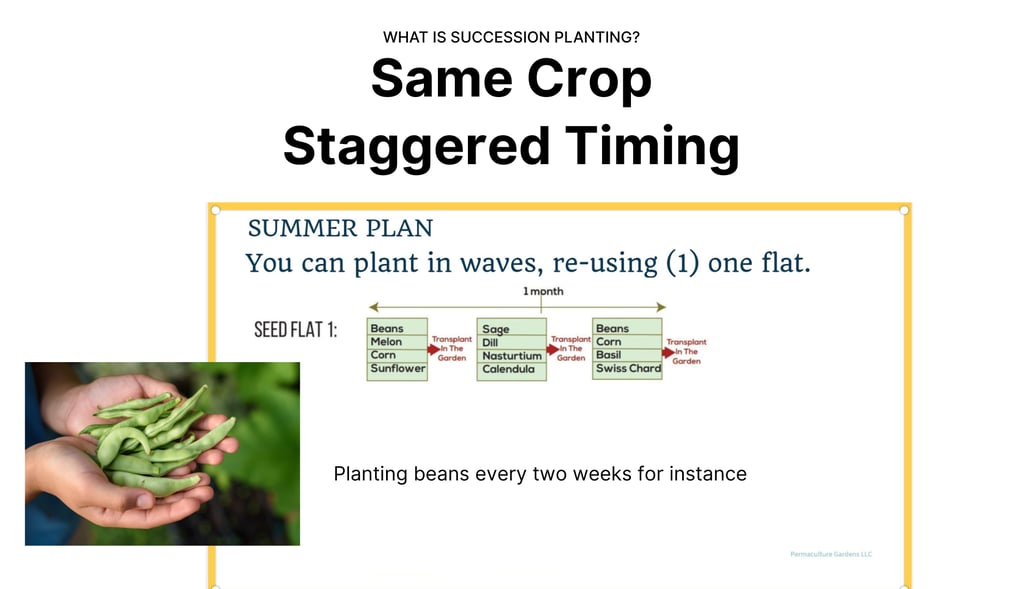
1. Same Crop, Staggered Timing
This is the simplest succession planting technique: planting the same crop (like beans, for instance) every two. This way, you are never staring at one giant flush of harvest followed by nothing.
Instead of sowing all your bush beans on the same day in May, you sow a short row every two weeks through early summer.
Even Thomas Jefferson is said to have recommended sowing a thimble full of lettuce every Monday morning from February 1 to September 1.
2. Different Crops in Sequence
This technique is the one we find most gardeners actually mean when they say "succession planting."
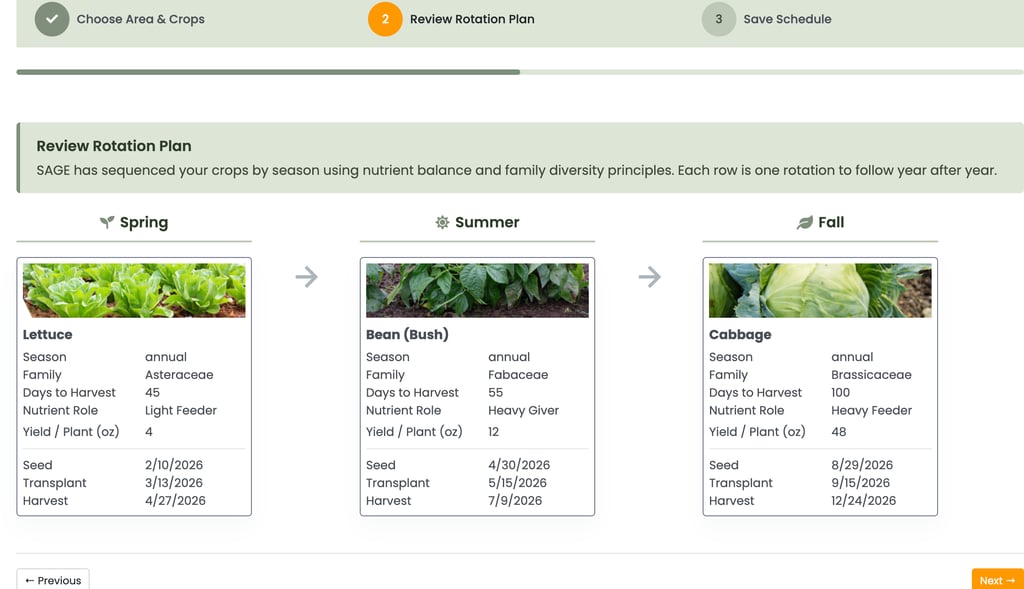
First plant one crop, followed by another and then another different crop so as not to deplete the soil. An example of this could be planting lettuce, then beans, then fall greens, all in the same bed.
Or arugula, then tomatoes, then fava beans. One crop finishes, you clear it, and the next one goes in the same footprint.
3. Ecological Succession
Planting in succession with the ecology in mind is the deeper layer, mimicking how nature fills space continuously.
Nature never leaves bare soil for long. A gap opens, something fills it.
Fast growing crops fill gaps quickly while slow crops need time to establish themselves so that when the fast crops are harvested, something else is already living in the soil and ready to fill the void that the harvest leaves.
This is the mindset behind everything else in this guide. How do we grow in succession so that there is diversity, and no time or space is wasted in growing an abundant and continuous harvest!
Succession means keeping a bed continuously productive instead of planting it once and leaving it. It can mean:
Planting the same crop in staggered waves (beans every two weeks),
Moving different crops through the same bed in sequence (lettuce, then beans, then fall greens), or
Designing plantings that fill space the way nature does, continuously.
So when we say, successop planting we mean, not just one technique but three, and knowing which one you are using changes how you plan your beds.
Planning Your Summer Garden
What Should You Be Planting Right Now?
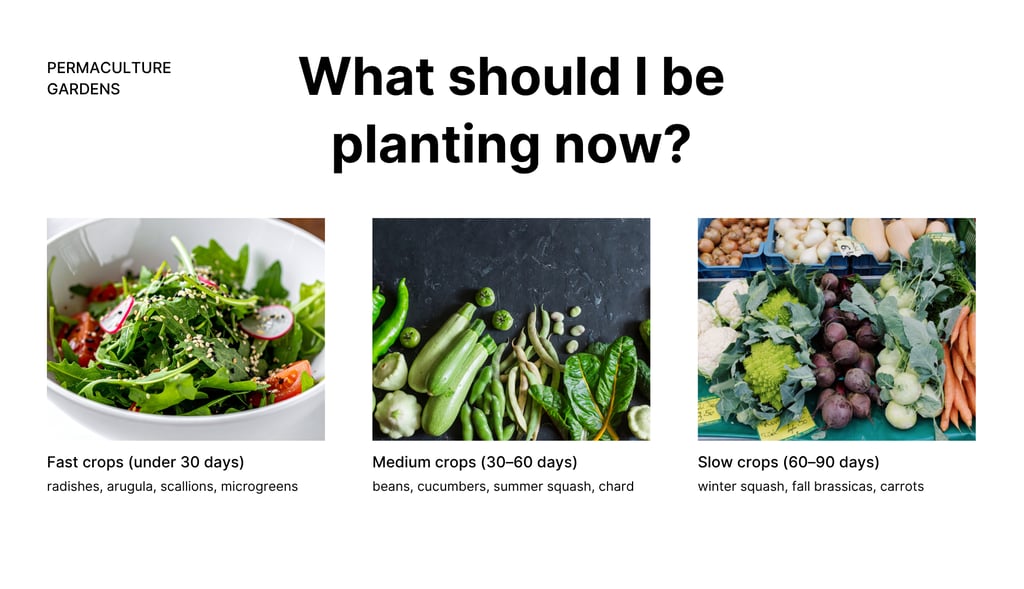
We also think about annual veggies in three "speed" categories, and knowing which bucket a crop falls into tells you how to use it in a succession plan.
Fast crops (under 30 days) — radishes, arugula, scallions, microgreens. These are your gap-fillers, the crops you tuck into a bed for a few weeks while you wait on something slower.
Medium crops (30–60 days) — beans, cucumbers, summer squash, chard. These are your workhorses through the heart of summer.
Slow crops (60–90 days) — winter squash, fall brassicas, carrots. These need to go in early enough that they still have time to finish before frost.
.
The Summer Plant Families
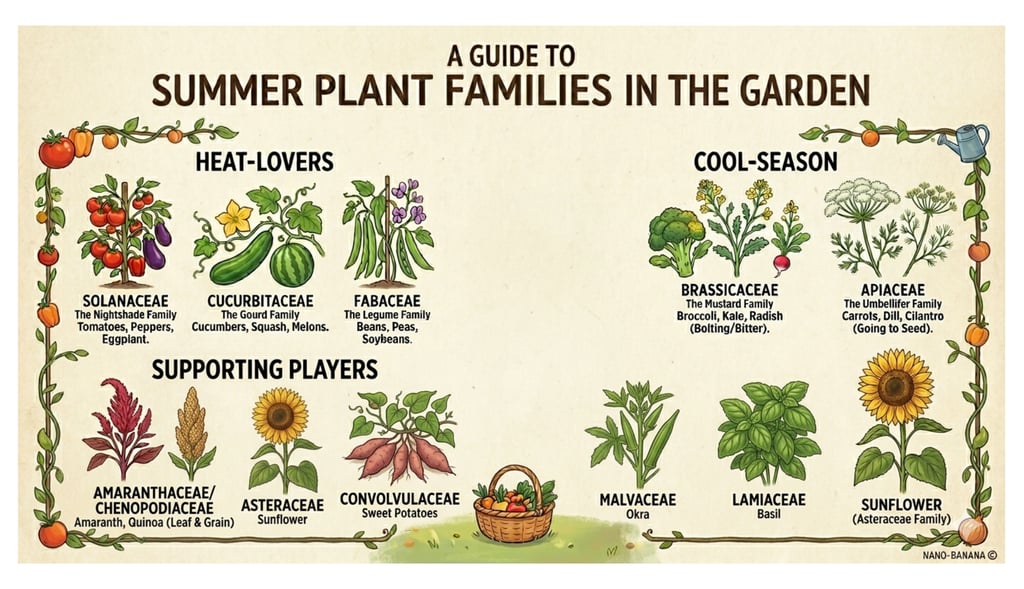
Before you plan what goes where, it helps to know which family you are actually working with, because families share pest pressure, nutrient needs, and rotation rules.
Heat-lovers
Solanaceae (the nightshade family — tomatoes, peppers, eggplant),
Cucurbitaceae (the gourd family — cucumbers, squash, melons), and
Fabaceae (the legume family — beans, peas, soybeans)
Cool-season
Brassicaceae (the mustard family — broccoli, kale, radish, which bolt and turn bitter in heat) and
Apiaceae (the umbellifer family — carrots, dill, cilantro, which go to seed)
Supporting players
Amaranthaceae and Chenopodiaceae (amaranth, quinoa)
Asteraceae (sunflower)
Convolvulaceae (sweet potatoes)
Malvaceae (okra), and
Lamiaceae (basil)
Once you know a crop's family, you know its season, and once you know its season, you know what should be waiting behind it in the succession line.
Succession Planting in Practice Inside Our Raised Beds
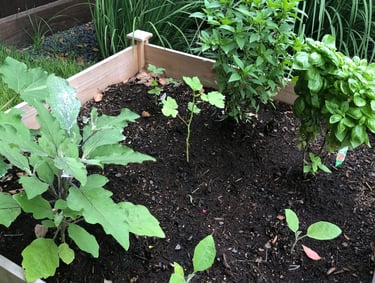
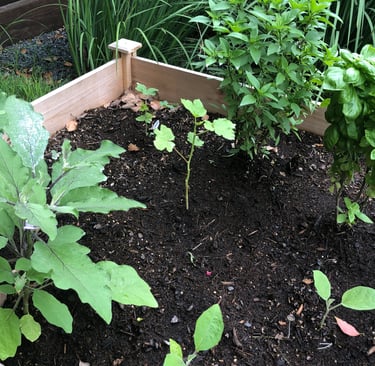
The clearest way we know to explain succession planting is to show you two actual raised beds, mid-season, doing it.
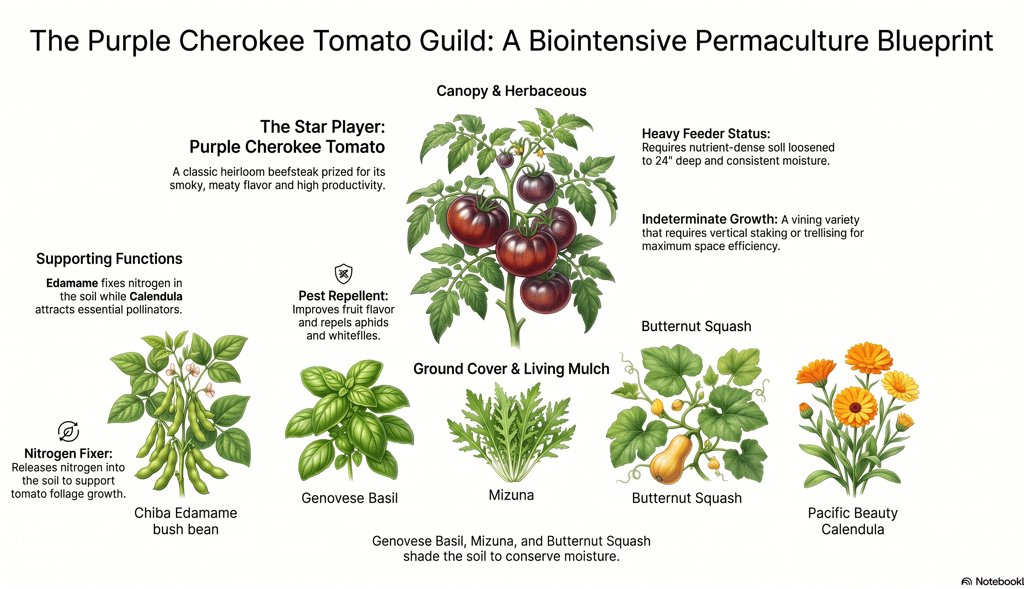
Raised Bed 1: The Tomato Guild
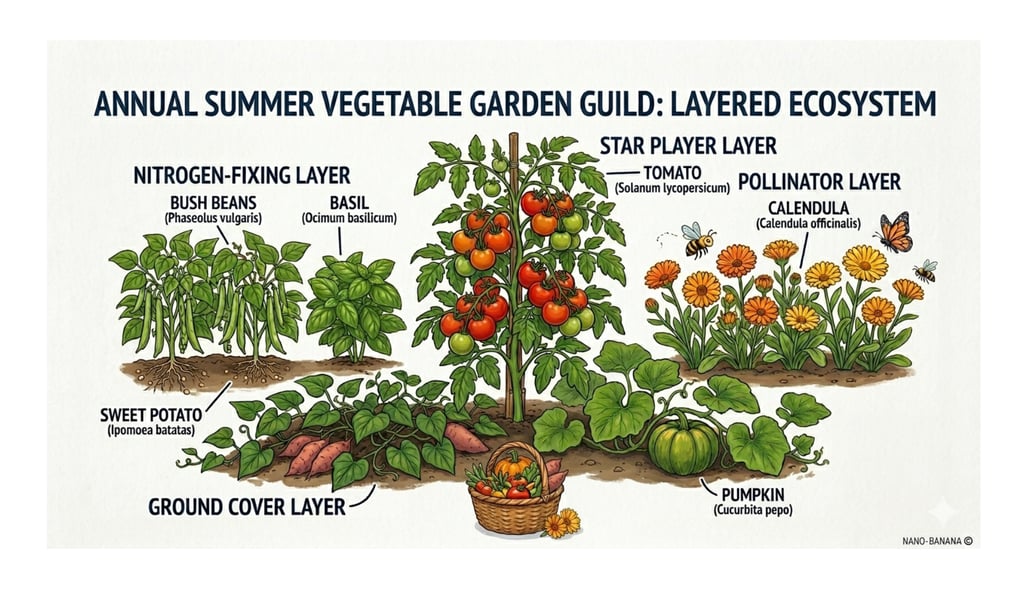
This bed is built around a tomato as the star player, with everything else chosen to support it. Purple Cherokee tomato in the center, Genovese basil, Mizuna, Pacific Beauty calendula, bush bean (Chiba edamame), winter squash (Butternut), and a second planting of Genovese basil filling out the space.
Think of it in layers. The canopy and herbaceous layer is your star player and your heavy feeder — the tomato itself. The ground cover layer is your living mulch and shade-tolerant plants — the basil and mizuna working underneath. The root zone layer is where spatial harmony and deep rooting happen underground, out of competition with everything above.
Nitrogen-fixing bush beans and basil feed and protect the tomato. Calendula pulls in pollinators. Sweet potato and winter squash cover the ground so weeds never get a foothold. Nothing in this bed is filler — every plant is doing a job.
Raised Bed 2: The Sweet Potato & Cucumber Bed
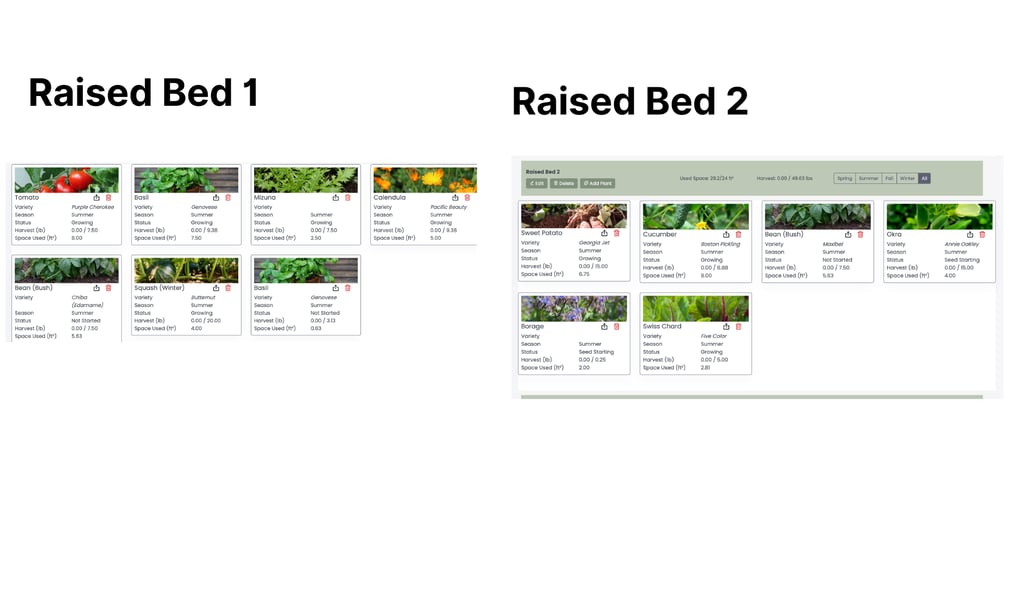
The second bed runs a different combination: sweet potato (Georgia Jet), cucumber (Boston Pickling), bush bean (Maxibel), okra (Annie Oakley), borage, and Five Color Swiss chard.
Notice what is happening here that is easy to miss: The sweet potato is doing ground-cover duty the same way basil did in Bed 1, the beans are fixing nitrogen again, and the chard is a cut-and-come-again crop that can be harvested from repeatedly rather than pulled all at once.
That is succession planting built into a single planting, not just a sequence of plantings over time.
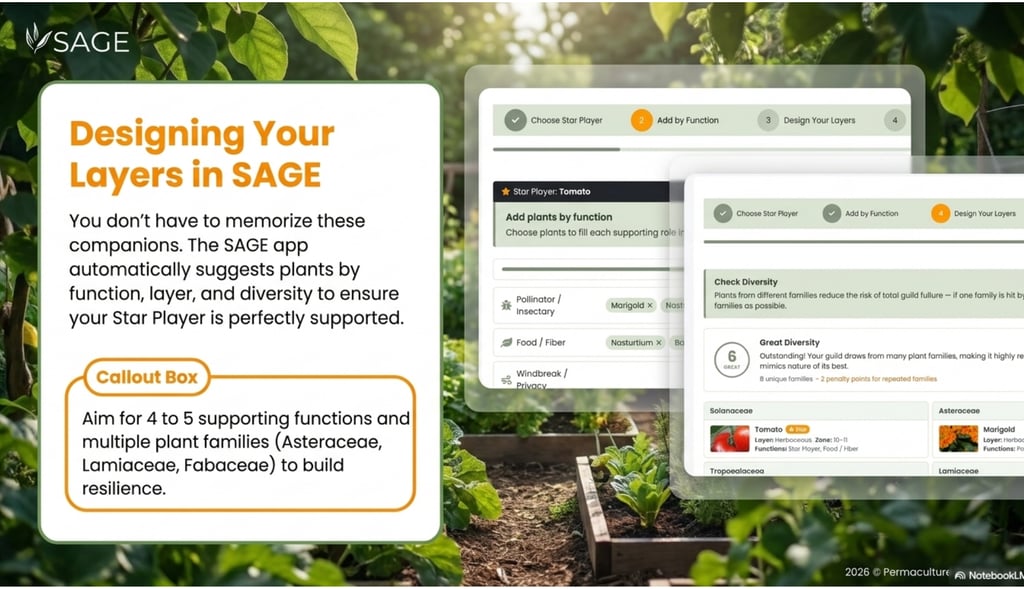
We track every planting like this in SAGE, which is genuinely the easiest way we have found to see, at a glance, what is growing, what is finishing, and what should go in next, right down to variety name, days to harvest, and space used per bed.
Summer Salad Succession
Heat-Tolerant Lettuce
"Heat-tolerant lettuce" is a bit of an oxymoron.
Lettuce cannot really survive temperatures consistently above 90 F degrees.
But you do have real options:
Find shady microclimates by planting lettuce to the east or south of taller crops.
Use a modern shade cloth cover.
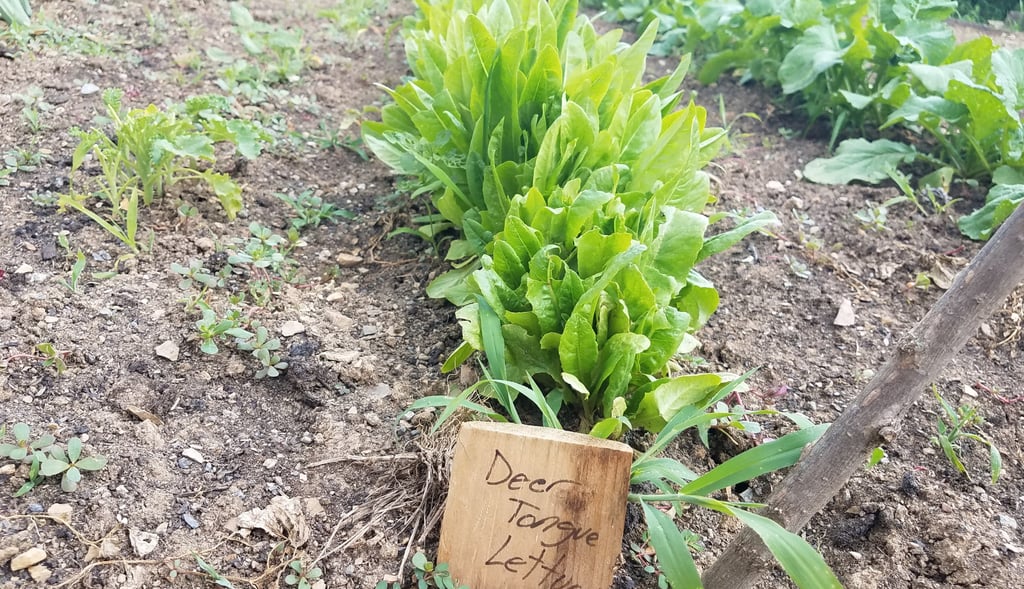
Choose heat-tolerant varieties like "Kragaener" or other known "open-pollinated" ones that are the slow-to-bolt, and often have leaves that are the, "deer-tongue" type
andHarvest lettuce leaves young. Baby lettuce greens harvested at three to four weeks, before the plant hits heat stress, are more tender and less bitter than anything you'll get off a mature, stressed plant.
Consider growing lettuce indoors or growing microgreens
Succession Greens for the Gaps
When lettuce taps out, these are the three greens we reach for to fill the gap:
Malabar spinach — vining, loves heat and humidity, uses vertical space so it does not compete for bed footprint.
New Zealand spinach — spreads low, drought tolerant, and cut-and-come-again, so one planting keeps giving.
Callaloo (Kalalou) — a Caribbean amaranth. Quick-growing, heat-loving, no pest pressure, and it is genuinely perfect for the exact gap left when garlic comes out of the ground in late June.
Three Summer Salads From the Garden
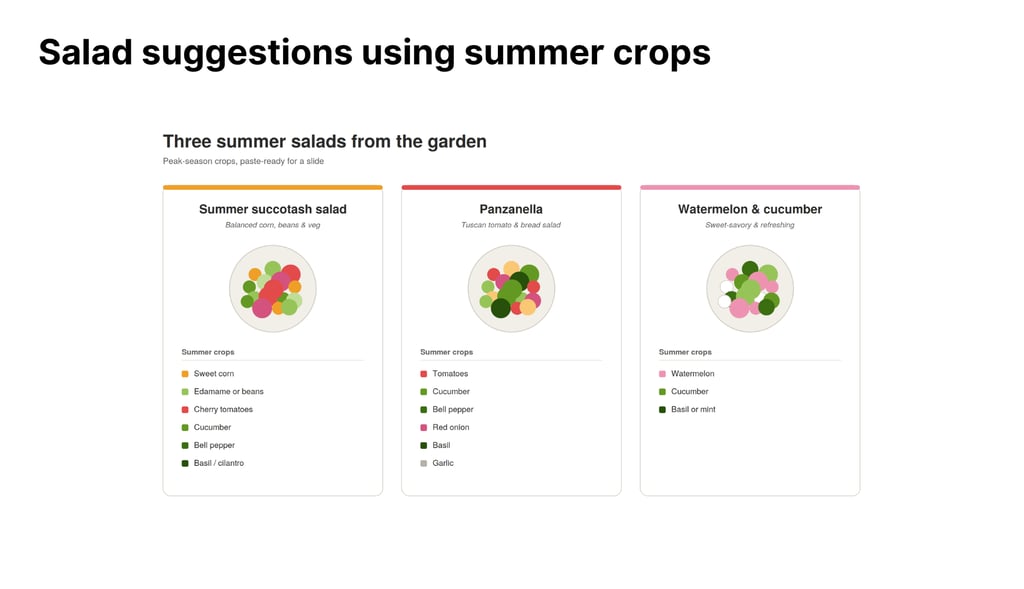
Once you have the succession crops going, here is what we are actually eating with them. Three summer salads, straight from what is in the beds:
Summer succotash salad — sweet corn, edamame or beans, cherry tomatoes, cucumber, bell pepper, basil or cilantro.
Panzanella — tomatoes, cucumber, bell pepper, red onion, basil, garlic.
Watermelon and cucumber — watermelon, cucumber, basil or mint.
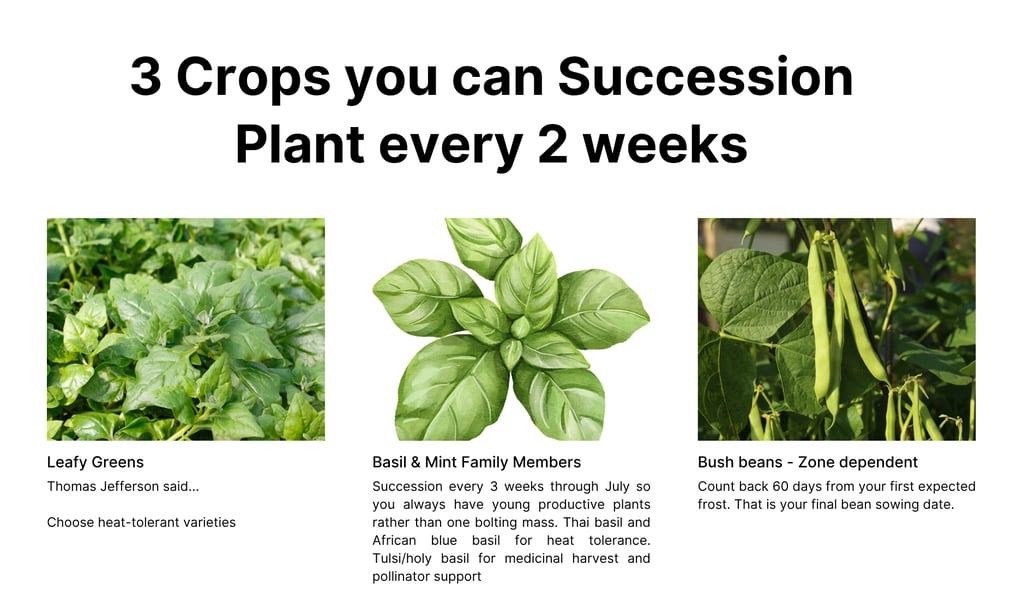
3 Crops You Can Succession Plant Every Two Weeks
Leafy Greens
You can stagger your plantings on purpose so your family never ran out of fresh greens. Choose heat-tolerant varieties and you can keep this going right through summer.
Basil & the Mint Family
Succession every three weeks through July so you always have young, productive plants coming on rather than one bolting mass all at once. Thai basil and African blue basil hold up well in heat. Tulsi, or holy basil, earns its space for medicinal harvest and the pollinators it draws in.
Bush Beans — Zone-Dependent
Count backward 60 days from your first expected fall frost. That date is your final bean sowing date. Anything planted after that will not have time to produce before the cold comes in.
Practical Summer Garden Tips
How Do I Transplant in Summer Heat?
Observe the microclimate first. Where does your land create natural cooling? Plant into those spaces. Transplant in the evening, not the morning, and water the hole before the plant goes in, not after.
How Do I Water My Summer Garden?
Ground-level drip rather than overhead. Keep the ground mulched — woodchips for perennials, straw for annuals, or use what you already have, like grass clippings. The goal in every case is the same: deliver moisture directly to the root zone instead of losing it to evaporation off bare soil.
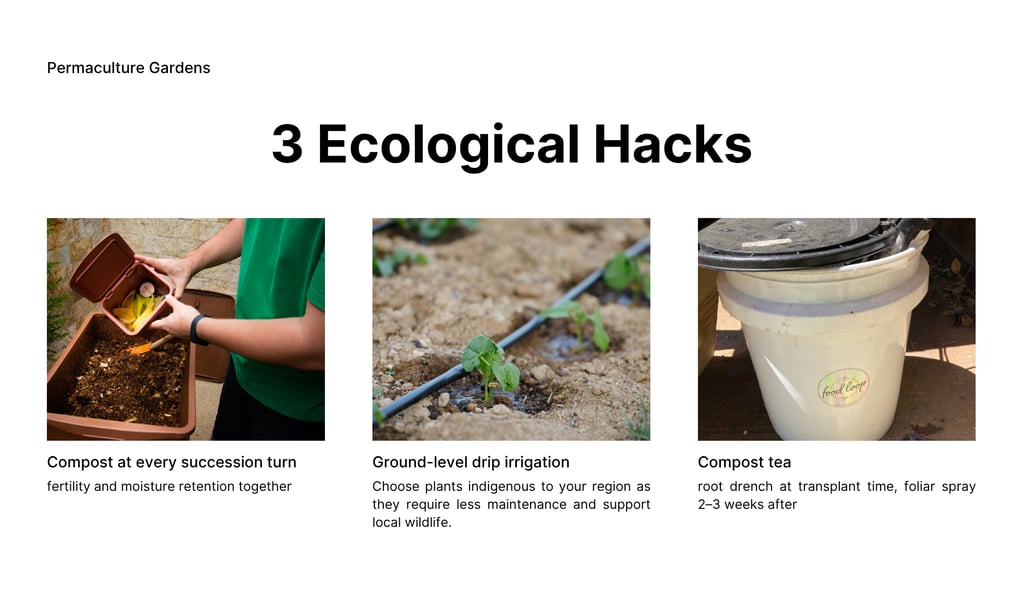
3 Ecological Hacks
Compost at every succession turn. When one crop comes out and the next goes in, that is your moment to add compost — it handles fertility and moisture retention together in one pass.
Choose plants indigenous to your region where you can. They require less maintenance and support local wildlife, and pairing that with ground-level drip irrigation keeps water use efficient at the same time.
Compost tea. Use it as a root drench at transplant time, then a foliar spray two to three weeks after.
Don't Forget the Flowers
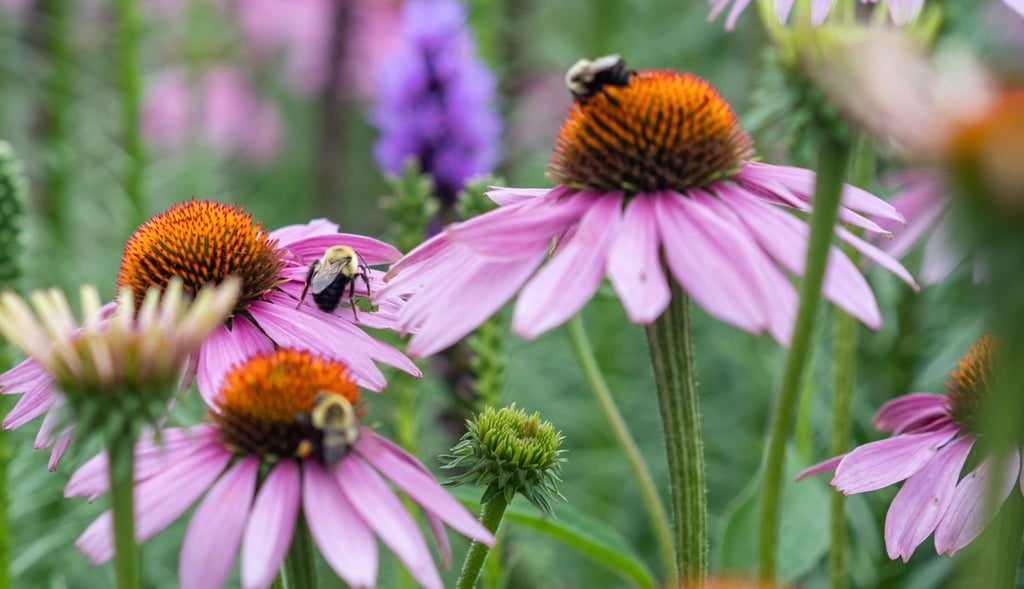
It is a good idea to add perennials to any annual veggie garden, and flowers are the easiest way to do it.
Calendula, nasturtium, and marigold germinate and bloom fastest if you want quick pollinator support this season.
Perennials like echinacea, bee balm, black-eyed Susan, and milkweed take longer to establish but come back year after year, building pollinator habitat that your annual succession beds can lean on all season long.
Summer Insect Management
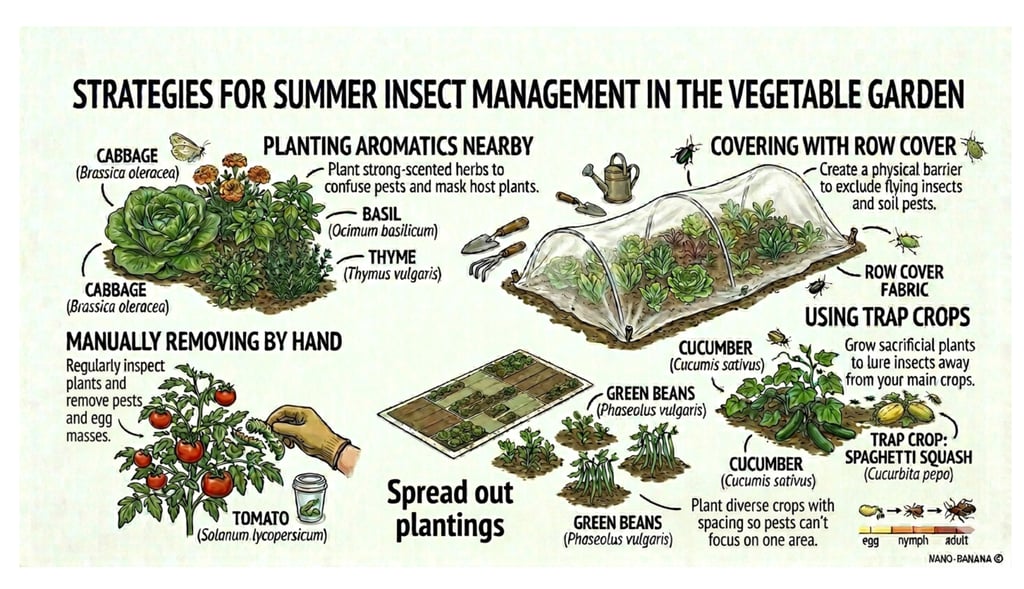
Plant strong-scented aromatics like basil and thyme near vulnerable crops like cabbage to confuse pests and mask host plants.
Cover vulnerable beds with row cover fabric to physically exclude flying insects and soil pests.
Inspect plants regularly and remove pests and egg masses by hand. This tips is still one of the most effective tools you have on a tomato plant.
Spread plantings out rather than clustering one crop in a block, so pests cannot focus on a single dense area. And where pressure is heavy, grow a trap crop like spaghetti squash to lure insects away from the crops you actually want to harvest.
Frequently Asked Questions
What is succession planting?
Succession planting means keeping a bed continuously productive instead of planting it once and leaving it. It can mean:
Planting the same crop in staggered waves (beans every two weeks),
Moving different crops through the same bed in sequence (lettuce, then beans, then fall greens), or
Designing plantings that fill space the way nature does, continuously.
How often should I succession plant lettuce or summer greens?
Lettuce and other fast greens can be resown roughly every two to three weeks in spring and early summer, before heat makes lettuce bolt.
Once temperatures hold above 90 degrees, switch to heat-tolerant greens like Malabar spinach, New Zealand spinach, or callaloo (see above) instead of fighting lettuce through the hottest stretch.
What can I plant every two weeks in summer?
Only heat-tolerant leafy greens (like the above-mentioned ones) bush beans (up until 60 days before your first fall frost), basil or other mint-family herbs (every three weeks through July) are the three crops we rely on most for a steady, staggered harvest all season.
What can I plant after garlic comes out of the ground?
Late June, when garlic is harvested, is the exact gap callaloo (Kalalou) was made for. It is quick-growing, heat-loving, and has shown no pest pressure in our beds, a near-perfect follow crop.
How do I keep lettuce from bolting in summer heat?
Plant it in a shady microclimate, to the east or south of taller crops, or use a shade cloth cover. Choose heat-tolerant varieties like Kragaener or Deer-Tongue-type lettuces, and harvest young, baby greens at three to four weeks are more tender and less bitter than a mature, heat-stressed plant.
In the end, don't fight nature. If it bolts, it's a sign, to harvest the seed, and move on to your more seasonally-appropriate veggies.
What is the best way to water a summer vegetable garden?
As tedious as it may sound, hand-watering with a watering can is the best way to water a summer garden because you force yourself to look at your plants up close and personal.
If you are limited by time or physical ability, ground-level drip irrigation rather than an overhead watering sprinler system , paired with mulch — woodchips around perennials, straw around annuals is your second-best option.
The goal is getting moisture straight to the root zone instead of losing it to evaporation.
How do I transplant seedlings without losing them in summer heat?
Transplant in the evening rather than the morning, so the water has the chance to seep into the ground overnight and not get evaporated away. Water the planting hole before the seedling goes in rather than after, and look for the natural cooler microclimates your land already creates before you choose a spot.
Your Next Step
If you want help designing your succession beds — spacing, guild companions, timing every crop that comes in and out — that's exactly what SAGE was built for. Choose your star player and let the app recommend the supporting cast, layer by layer, the same way we planned the two raised beds in this guide.
Grow abundantly, Nicky & Dave
PS. And if you want to go deeper on any of this, the full webinar where Dave covers every variety in detail, and there's a lot in the Q&A that didn't make it into this article.
Permaculture Gardens - your online resource for organic & sustainable gardens.
Contact
permaculturegardens@gmail.com
Bethany Farm
41558 Stumptown Rd.,
Leesburg, VA 20176